An Dinh

An Dinh · Early Childhood Teacher · Sydney, NSW

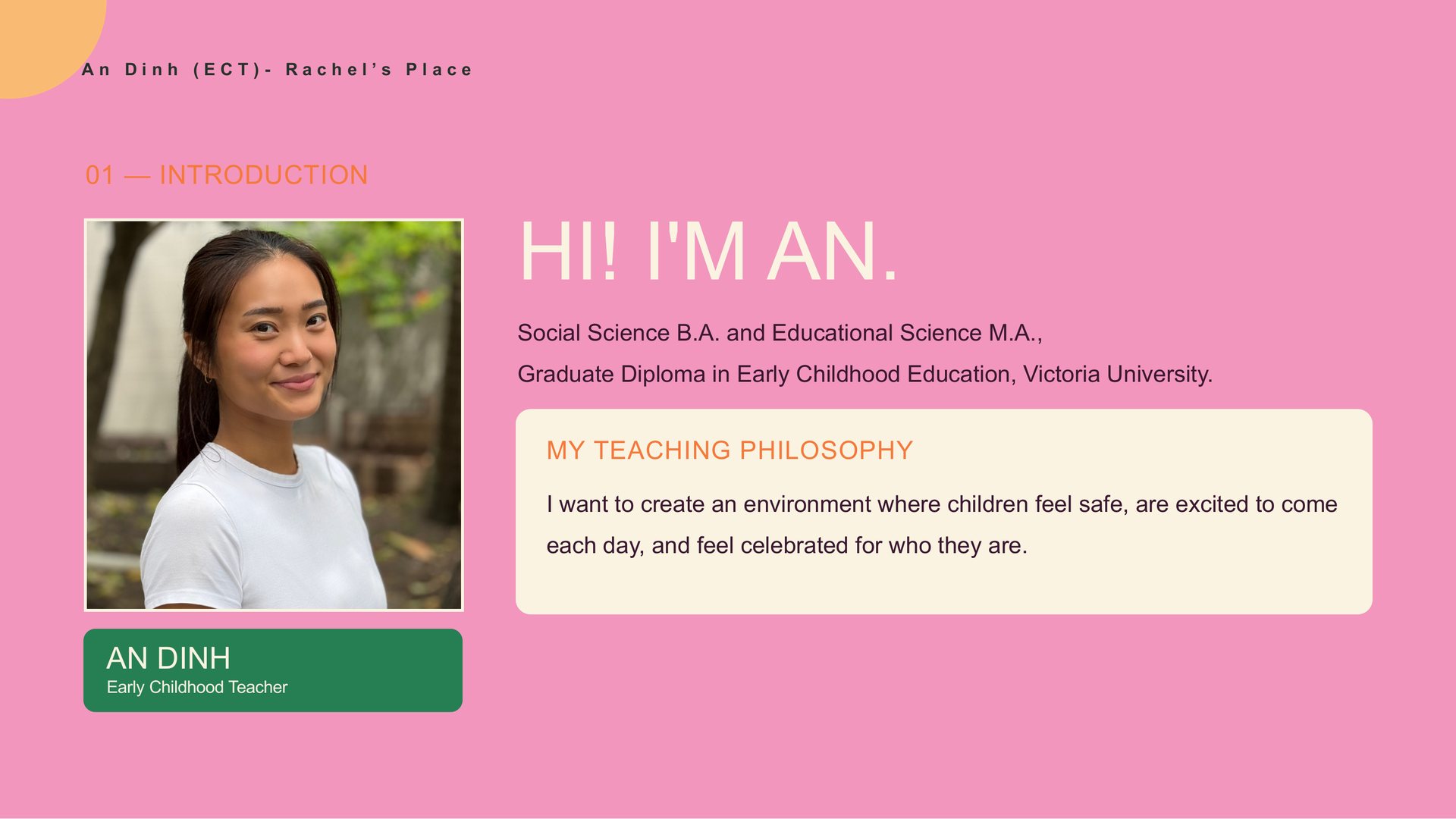
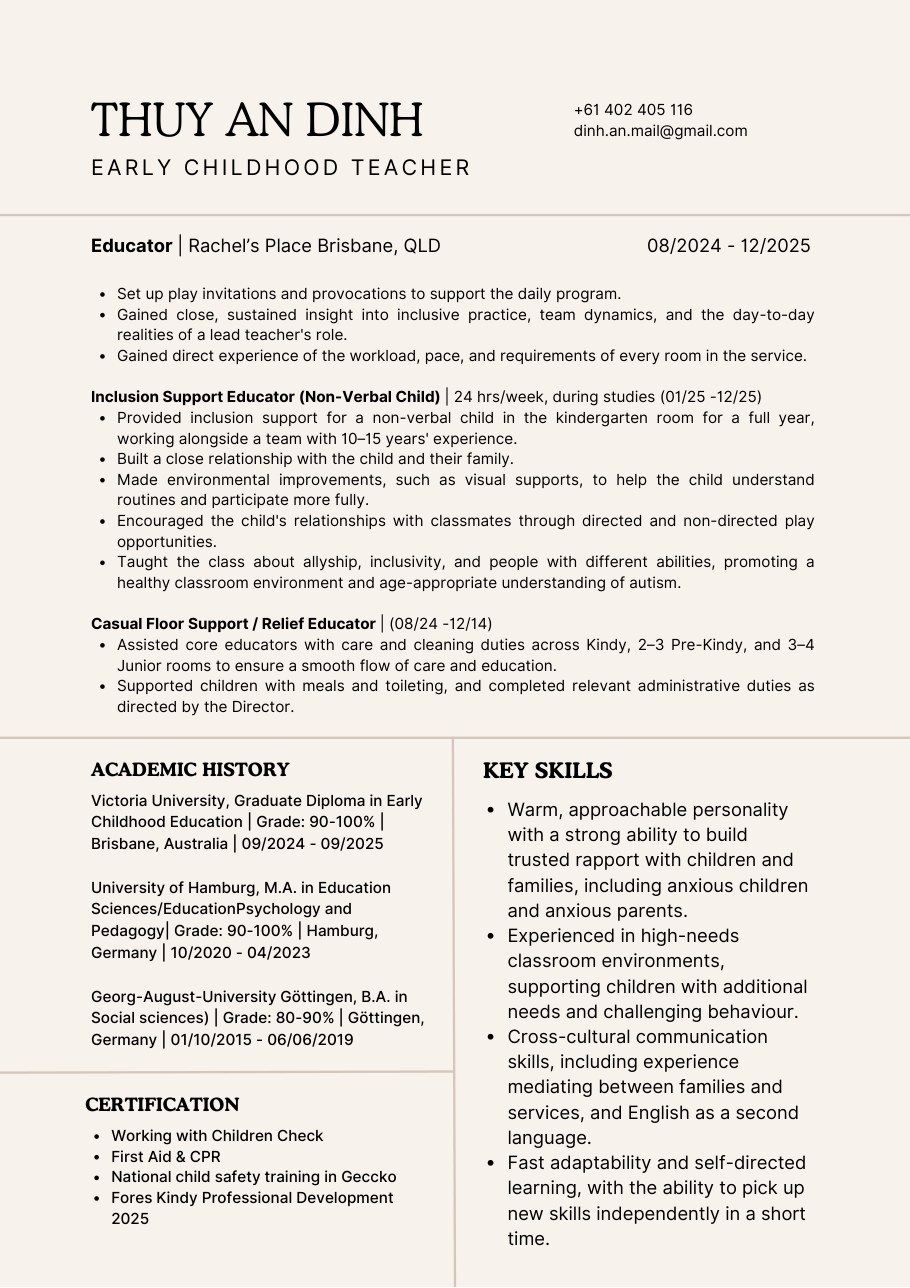
Hi, I'm An.

An ACECQA-approved early childhood teacher with experience leading a Kindy room. Warm, inclusive and child-led, I help every child and every family feel they truly belong.

Get in touch

Currently Kindy teacher and room leader at Rachel’s Place

  • Kindy teacher & room leader15–19 children, ages 3.5–5
  • ACECQA approvedGraduate Diploma, 90–100%
  • Fluent in 3 languagesEnglish · German · Vietnamese
  • Queensland Working with Children Check
  • First Aid & CPR
Portrait of An Dinh, Early Childhood Teacher in Sydney
About me

From Germany, with a Vietnamese heart

I was born and raised in Germany to Vietnamese parents, and I've made my home in Australia. Living across languages and cultures shapes everything about how I teach, and how I welcome families who are far from home.

My story

Where I've come from, and where I'm heading
Raised in Germany, fluent in English, German and Vietnamese, with a Master’s in Education Sciences and an Australian teaching qualification earned with grades of 90–100%.

Read my story →
Read my story

Where I've come from, and where I'm heading

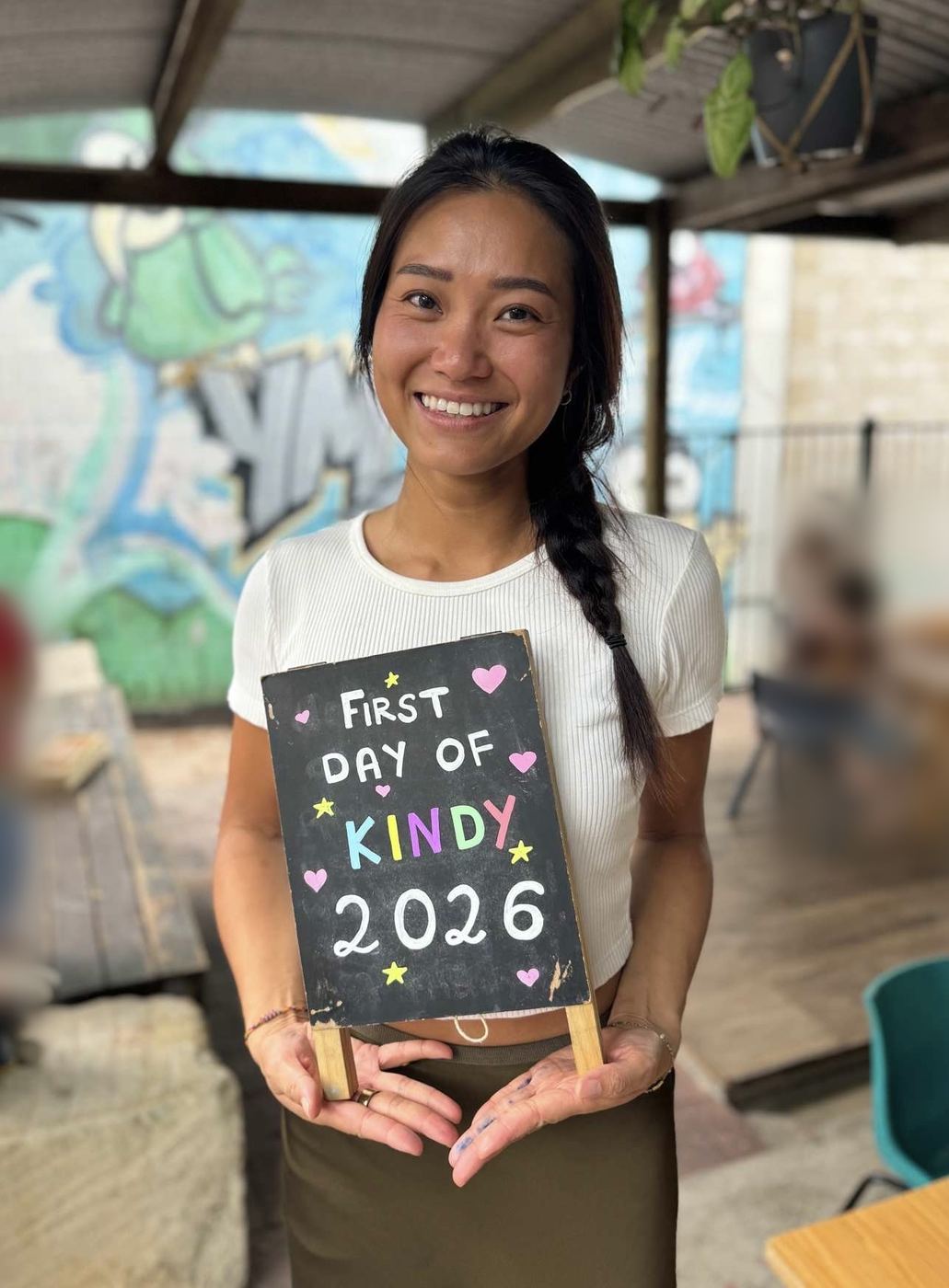
An holding a First Day of Kindy 2026 sign

"Every child deserves a place outside home where they feel truly loved and cared for, not only kept safe."

Where it started

I was born and raised in Germany to Vietnamese parents, and I was a long day care child myself. I know what it feels like to be in care five days a week, to be one of the first children dropped off in the morning and one of the last picked up in the afternoon. I carry that with me in how I care for the children in my room.

It also gives me real empathy for parents. Every family’s circumstances are different, and my role is to support them, never to judge.

How I learned to teach

I studied social science at Georg-August-University Göttingen, then completed a Master's in Education Sciences at the University of Hamburg, specialising in educational psychology and pedagogy, because I wanted to understand why children do what they do. In Australia I completed my Graduate Diploma in Early Childhood Education with grades of 90–100%, while working on the floor of a busy long day care service.

I have grown through every role in the room: relief educator across the junior, pre-kindy and kindy rooms; a full year as inclusion support for a non-verbal child; and now Early Childhood Teacher leading the kindy program. That path gave me a practical understanding of every role on a team, and real respect for the educators I now lead.

I was very fortunate to work alongside a strong team with more than 15 years of experience. I asked many questions, and my teaching identity was shaped by their feedback and the wisdom they shared with me.

With my science background, I also feel strongly about grounding my curriculum in evidence-based research.

The teacher I am

Families describe me as warm, loving and supportive. I am at my best building deep connections with families and children, especially anxious children and anxious parents.

I want to support children to be confident in their own capabilities, proud of their roots, and allies to the people in their world. Day to day, I plan an emergent, play-based program under the EYLF V2.0, write detailed summative assessments and communicate with families every day. I speak English, German and Vietnamese, and I tell every family never to apologise for practising a second language.

Where I’m heading

I’m relocating to Sydney and looking for a long day care service that values child-led learning, inclusion and genuine partnership with families. I hold a current Queensland Working with Children Check, and my NESA accreditation and NSW Working with Children Check will be in place before I start.

Learning I’m committed to

As someone who wasn’t raised here, I want to keep deepening my understanding of First Nations cultures, Country and Australian culture, so I can embed these perspectives with care and accuracy.

I would also love to learn Auslan, so I’m even better equipped with the tools to include every child and family.

Where I want my career to go

In the near term, I want to keep building my experience as a teacher. In the longer term, I’m working towards becoming an Educational Leader, supporting a team to plan, reflect and grow its practice, and mentoring new educators the way experienced teachers once mentored me.
learning alongside the children

Weekly excursions
Out-of-the-box art
Mapping our suburb
Loose parts invitation
Gathering together
Teaching philosophy

Children as capable, curious people

Six principles that guide my practice, grounded in the Early Years Learning Framework (EYLF V2.0) and the National Quality Standard. Select any to read more.

I want to create an environment where children feel safe, are excited to come each day, and feel celebrated for who they are.

Child-led learning

An emergent curriculum built on careful observation of what children are excited about and keep coming back to.

Read more →
Read more

Child-led learning

I work within a child-led, emergent curriculum. The thinking behind it is simple: children learn best when they are engaged, and they are most engaged when they are intrinsically motivated and genuinely interested. So my planning starts with observation, noticing what excites the children and where their interest keeps circling back to, and building the program from there.

Within that, I shape each term around an umbrella topic, such as “Things that Go” or “Find Our Voice”, then follow the children’s questions wherever they lead. Talk of knots became finger-knit friendship bracelets. A hairdresser visit became a salon role play and a scissor-skills project. A new friend who loves fishing brought us back to designing fishing rods.

This year my service transitioned to the ROSE way of planning, which gives me external professional development support and feedback, alongside my weekly pedagogy meeting with the other room leader and our service’s Educational Leader.

I document how a single idea moves through many hands. One ramp for racing cars became a water channel, then a measuring experiment, then a widened track with barricades and finally a bridge. My planning is guided by the Early Years Learning Framework (V2.0) and the National Quality Standard.

Kindy goals

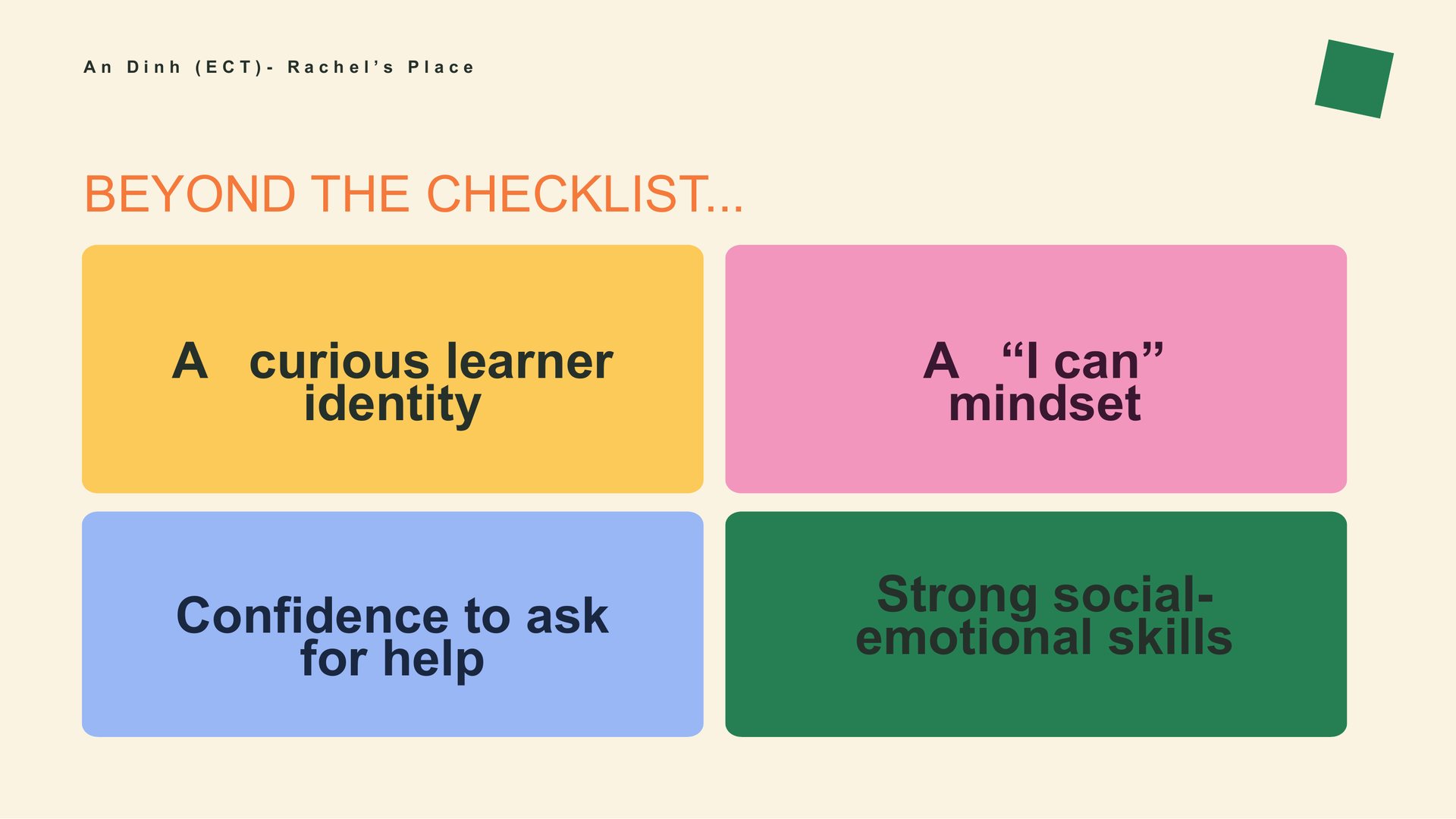
A curious learner identity, an “I can” mindset, the confidence to ask for help, and strong social and emotional skills.

Read more →
Read more

Kindy goals

Everything I plan for my Kindy children works towards four goals:

  • A curious learner identity. Children who see themselves as people who wonder, ask questions and love finding things out.
  • An “I can” mindset. The persistence to keep trying, and pride in what they can already do.
  • Confidence to ask for help. Knowing that asking is a strength, and knowing who and how to ask.
  • Strong social and emotional skills. Words for joining in, saying no kindly, naming feelings and finding their way back to calm.

These goals carry children into school. We practise the social language of play, such as “Can I join?” and “No thank you, maybe later”, and build independence in self-care: changing on their own after water and messy play, getting their own lunchboxes and water bottles, packing away and clearing the space afterwards, and checking and wiping their own faces after meals. I’ve also built a strong partnership with a local primary school, hosting their teachers and visiting the school grounds together.

Team leader

My team describes me as warm, fun, easy-going and reliable. I lead by working with my team, not over it.

Read more →
Read more

Team leader

My team describes me as warm and loving, fun and easy-going, and reliable and secure. I see my role as supporting the team and working alongside it, rather than over it.

I also see myself as the bridge between management and the floor team: someone the team can turn to when they’re struggling, and someone management can rely on too. I’m solution-oriented rather than someone who dwells on problems. My thinking is: this is the situation, let’s identify the problem together, work out what’s realistic for us, and how each of us can contribute to a better system.

I see a team like a car. Every part has a different role, but no part is more important than another; every part has to work for the whole system to run, and not fall apart in the long run.

One example: I reorganised our outdoor space so every resource has a labelled home, which made opening, closing and lunch cover easier, and I introduced an arts and crafts trolley that gives children open access to materials. When I make a change, I explain my reasoning and ask colleagues for honest feedback.

I know I will often hold the highest qualification in the room, but I’m also new to the industry and genuinely excited to learn from colleagues with more experience. Some things simply can’t be taught in lectures. Having worked through every role in the room, I believe I’m a more empathetic and understanding room leader. This year I have also supervised and mentored two student teachers on placement.

Family partnerships

Deep, genuine connections with every kind of family, that go well beyond daily small talk.

Read more →
Read more

Family partnerships

Working in a small service gave me the opportunity to build strong, deep connections with families, beyond the daily small talk. I’ve built relationships with many different parent personalities, from busy, to anxious, to connection-seeking, and learned a lot about myself along the way: how I handle difficult conversations, and how to build connections that are genuine rather than tokenistic.

That has looked like regular catch-up conversations with a single parent who had just moved to Brisbane with no support network. It has looked like joining meal trains for two families facing medical emergencies, and connecting over food so we had something to talk about beyond the stressful medical news. And it has looked like supporting an anxious mother, who hadn’t experienced racism growing up, when her child began saying they didn’t like their tanned skin, and sharing my own experience to help.

Day to day, families hear from me through app updates, conversations at drop-off and pick-up, weekly recaps and individual observations, and I always share difficult news gently, alongside genuine positives and a clear next step.

Open-ended, inclusive play

Open-ended set-ups and flexible spaces that let every child, including those who need a different approach, take part and lead.

Read more →
Read more

Open-ended, inclusive play

For table activities and play invitations, I focus on open-ended set-ups. I love combining different materials, such as wooden blocks, fabrics and natural resources like rocks of different shapes and textures or pine cones, so the children decide what the play becomes. A child who is just starting out and a child who is ready for a challenge can work side by side at the same table.

Inclusion shapes every set-up. I think about noise, space and sensory load, offer quieter options alongside busy ones, and use visual supports so every child knows what is happening next. When I noticed the children becoming increasingly unsettled in the afternoons as the weather changed, I added sensory activities to the afternoon, along with tea time and opportunities for children to sit down and calm their bodies.

Wherever the learning happens, the room, the yard, a library or a local park, my focus is the same: intentional teaching, careful observation, and making sure every child can take part.

Wellbeing & belonging

Grounded in attachment theory: children learn best when they feel connected, safe and that they belong.

Read more →
Read more

Wellbeing & belonging

My teaching is heavily influenced by attachment theory: the belief that children learn best when they feel connected, safe and a true sense of belonging.

At the start of each year I focus on emotions and on building relationships between the children and their teachers. Together we make the space ours, with photos of the children, a family tree with pictures of their loved ones, and visual supports such as a daily routine schedule and meal-time expectations, so every child understands what is happening and what is expected of them.

I believe wellbeing and belonging don’t stop with the child; they extend to families. Children feel a stronger sense of safety when they see me catching up with their parents, sharing a laugh, or greeting them with a big smile in the morning. The effort I put into relationships with their most trusted adults strengthens my relationship with the children.

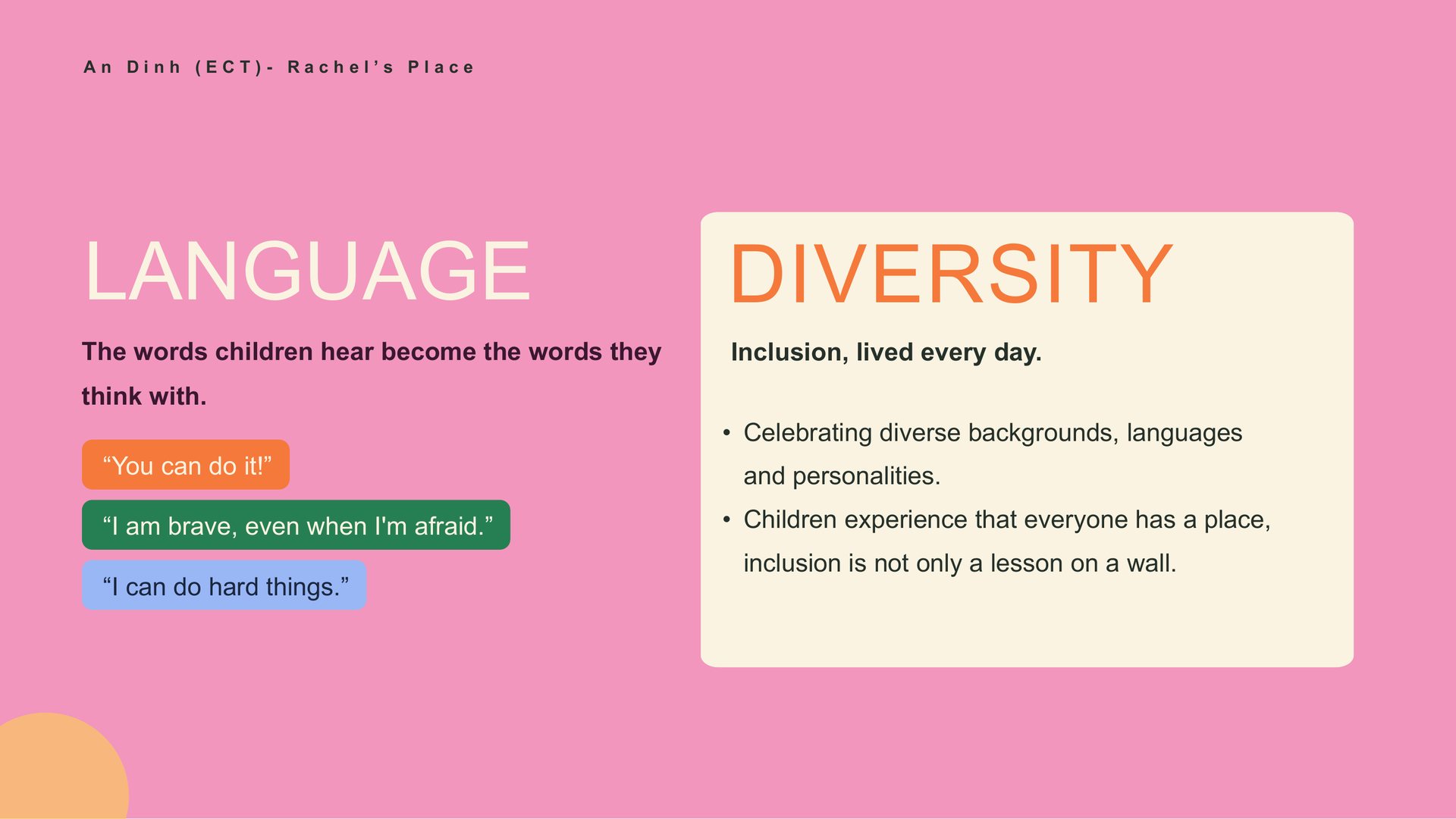
I use strength-based language with the children every day. The language children hear in early childhood becomes the voice they hear in their own heads later in life, consciously or not.

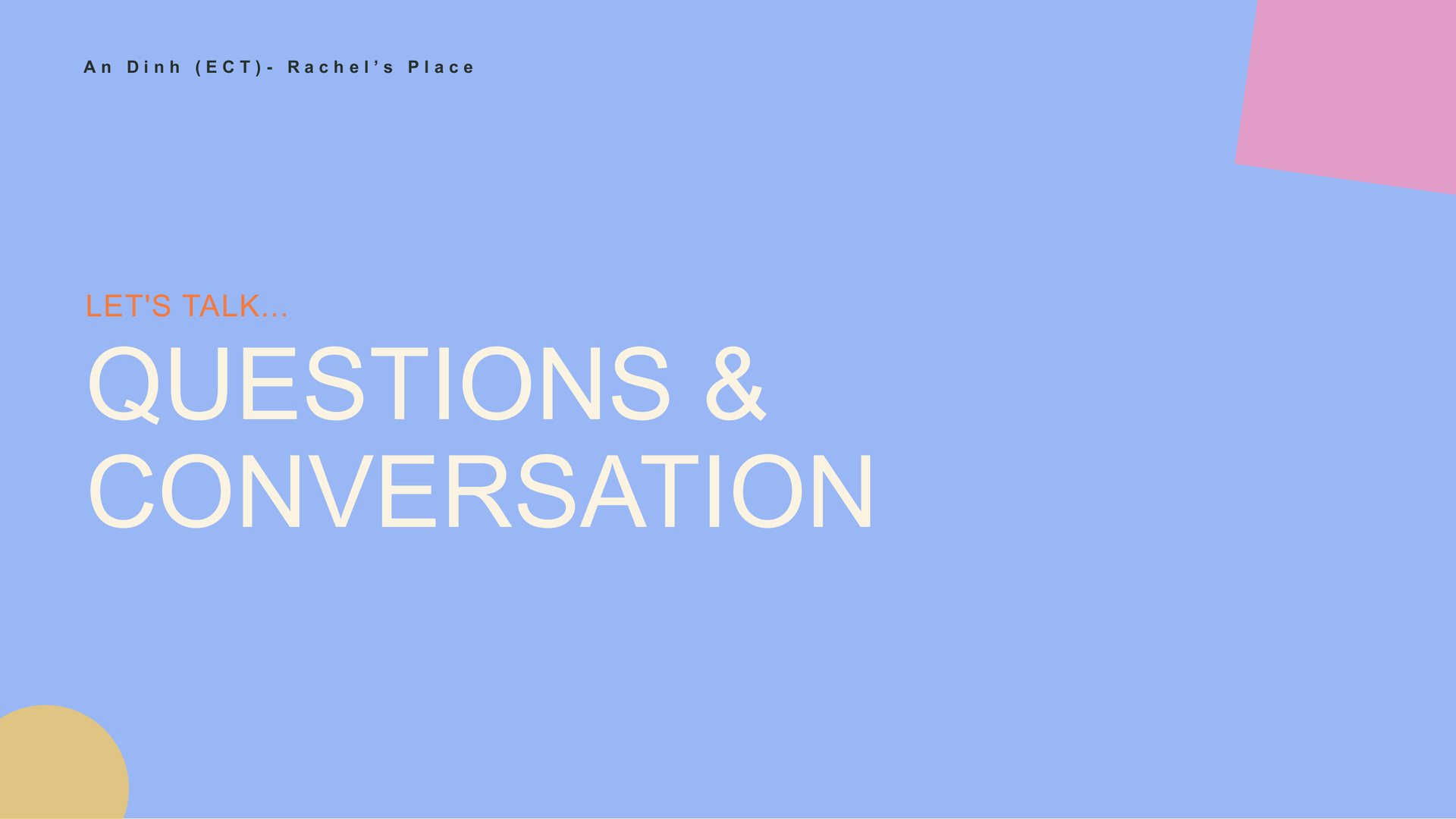
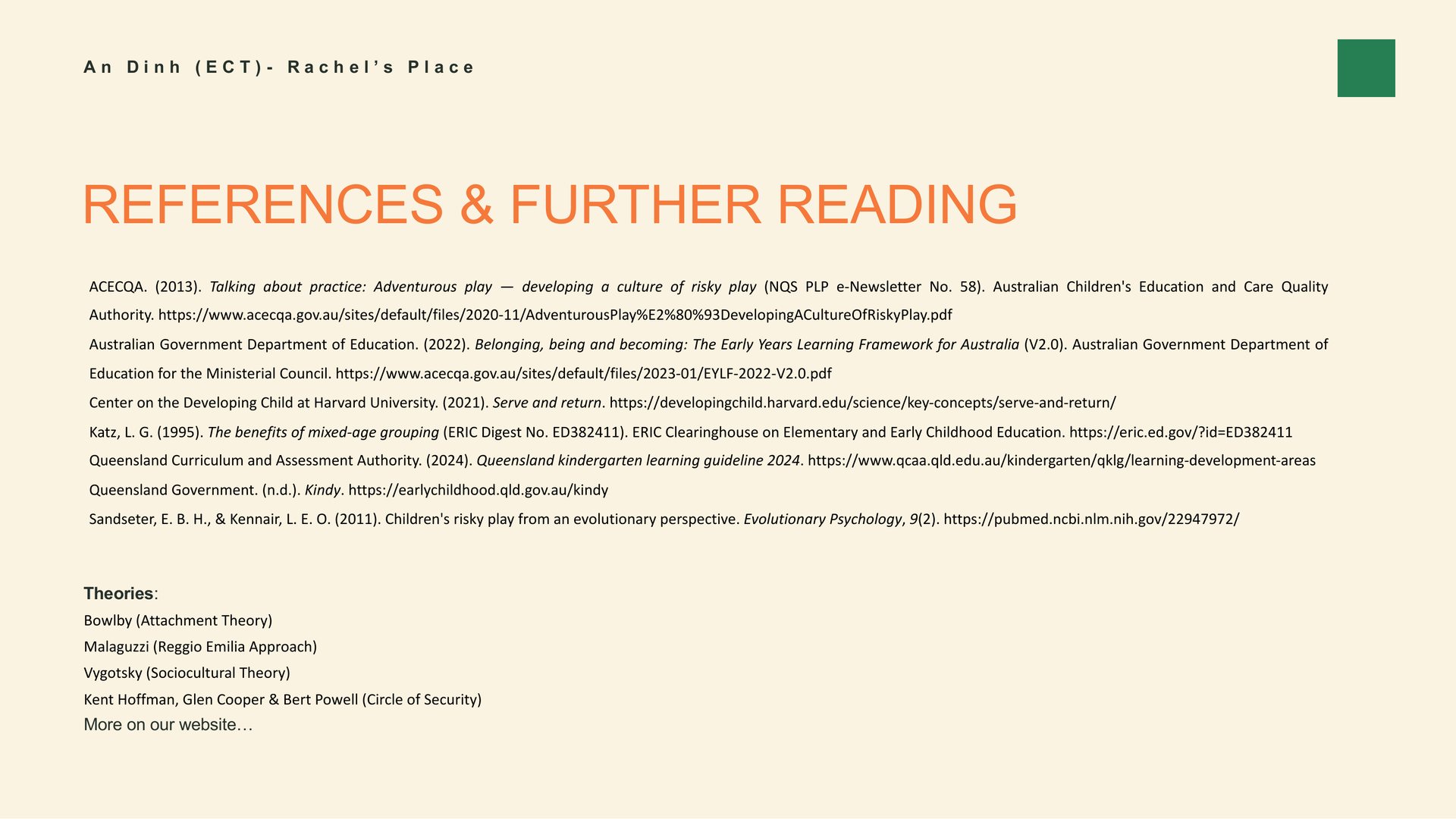
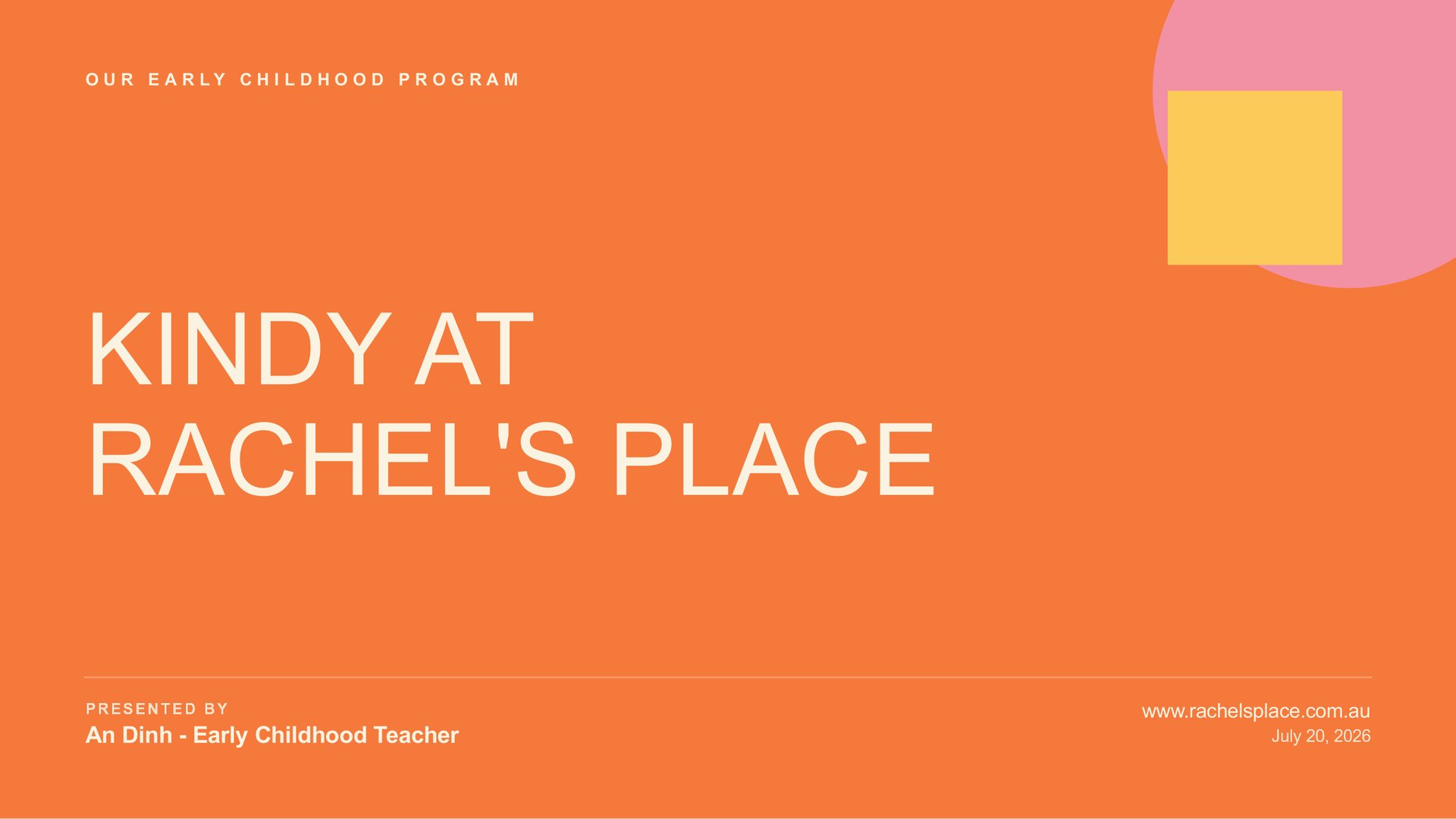
Title slide: Kindy at Rachel's Place, presented by An Dinh, Early Childhood Teacher
Presentation for families

Kindy at Rachel’s Place

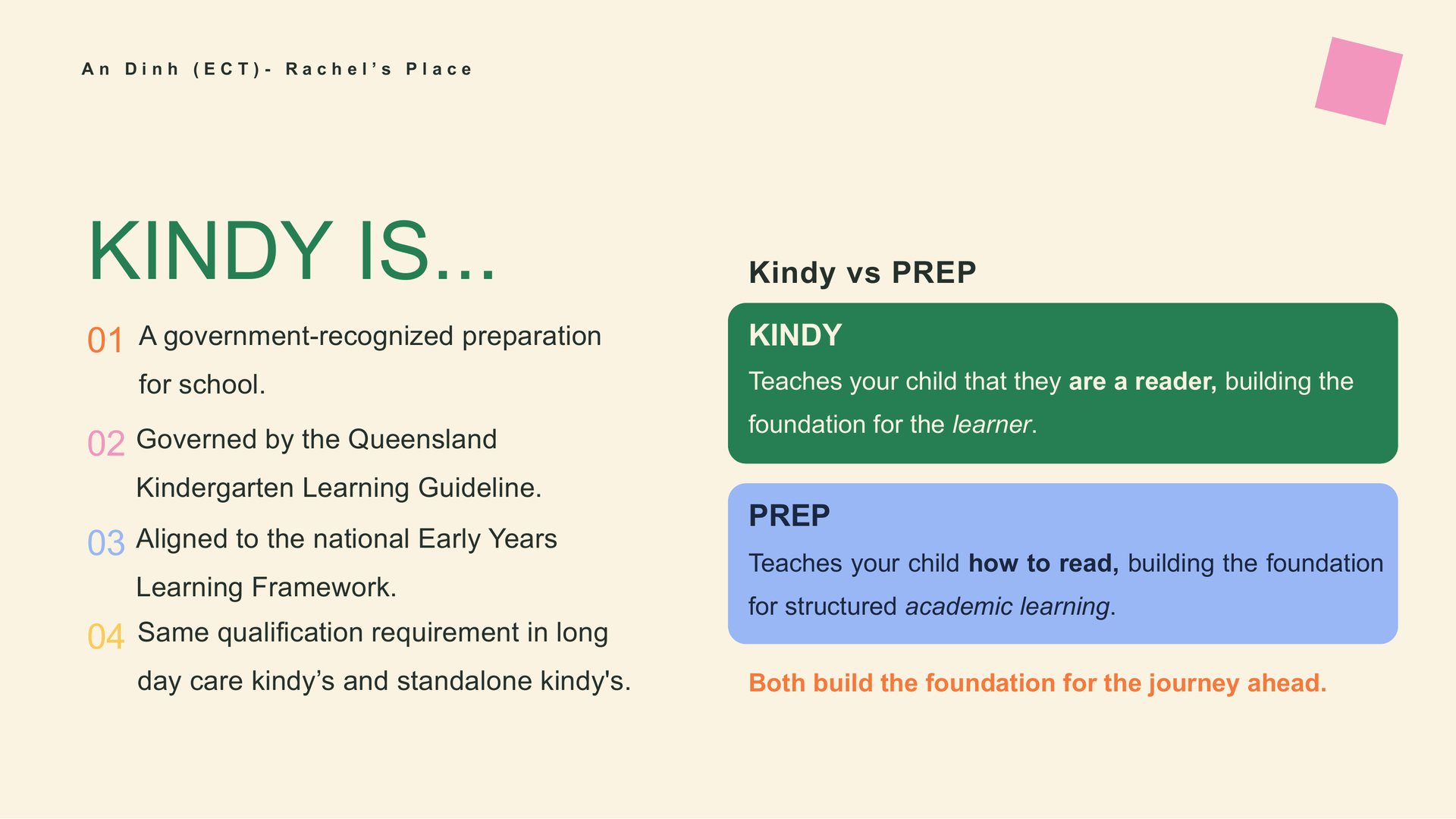
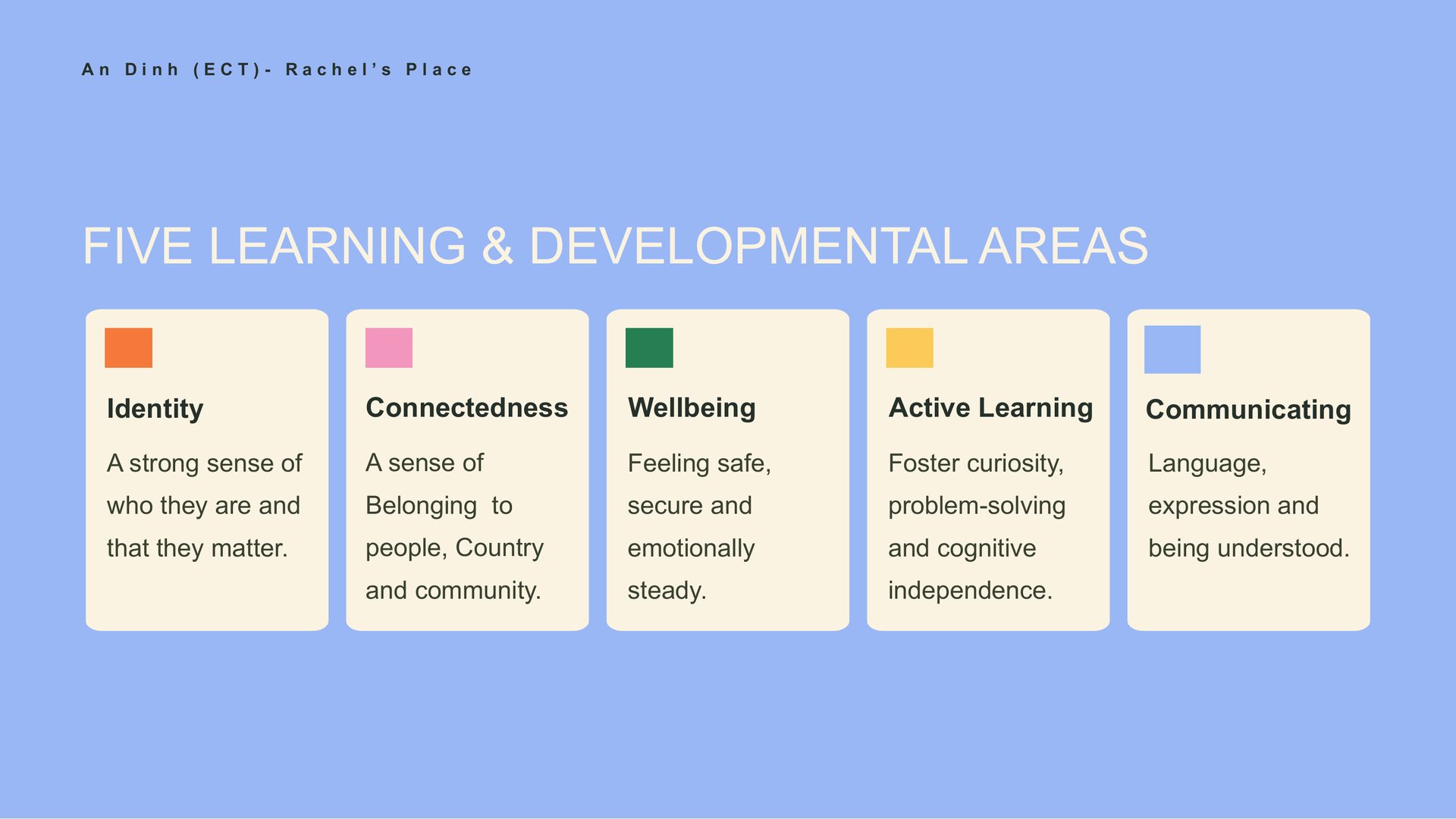
A breakdown of the Rachel’s Place philosophy (and my own!) that I created and presented for parents: what Kindy is, our goals for school readiness, and how our approach helps every child get there, followed by an open Q&A with families.

17 slides · open “What I said” at the top of the viewer to read my speaker notes View the presentation
Stories from my room

Little moments that say a lot

Twelve short, real stories that show how I teach, from deep listening by the creek to big feelings and new friendships.

Read the stories →
Read the stories

Little moments that say a lot

Real moments from my teaching. Children and families are not named.

Doing the scary thing

After a bush walk, an obstacle course grew from the boulders. Children tested jumps and climbs that felt a little scary and came away with big wins. When I shared the learning story with families, I explained why it had so few photos: my colleagues and I kept our hands free to support the children, choosing presence over photos.

“Leave things as they were”

After we learned about Aboriginal symbols at the service, the children independently marked a tree next to our base camp with the meeting place symbol, and a rock next to the creek with the running water symbol! Then they invented a symbol of their own, meaning “leave things as they were”. I was so excited to see how they were thinking like custodians, aware of their impact on the land.

Kookaburras answering back

At Forest Kindy, after a dadirri moment of quiet, deep listening on a high boulder, children noticed birdsong and answered with kookaburra calls. Three birds flew closer and called back. The children were in awe, experiencing how Country speaks back to us, and that communication happens beyond words.

The place has changed

Before we returned to our bush site in a new season, I read the children Ask Aunty: Seasons, an introduction to First Nations seasons, and Ernie Dances to the Didgeridoo by Alison Lester. When we arrived, the children immediately spotted that the creek had gone, the mushrooms we’d seen before weren’t there, and silky oak flowers covered the ground.

Living things up close

When some beans from our sensory tray escaped into the sandpit and began sprouting, the children wanted to know what was happening underground. We gently lifted the seedlings and laid them out in order, compared them with a children’s botany book and drew our observations. Then we planted them with spoons in our fairy garden and watched them grow, each at its own speed.

Love is Love

During Pride Month, the children explored what they understand about love: what love is, who they love, and how we can show it. They drew on a big poster and cut out paper hearts, and we wrote their own words on the hearts and glued them on. The finished “Love is Love” poster is full of their voices, and is proudly displayed in our entrance as a symbol of our service’s allyship.

A week of snapshots

A family who joined us later in the year told me they were worried their son had no friends, because he struggled to say who he played with at the end of the day. I explained how much happens in a child’s day, and how open-ended questions like that can overwhelm a child. I reassured them he does have friends, and photographed his play with peers over a week, so the family received evidence and reassurance, not just words.

A toy worth the risk

Before show and share day, the children and I did a risk assessment of the toys we were thinking of bringing. Together we agreed on three rules: the toy must be bigger than our fist so it can’t be a choking risk, it can’t have batteries, and it has to be labelled. On the day, the children checked each other’s toys and reminded each other of the rules.

Afternoon tea time

I brought back our service’s tea tradition when I noticed the children hadn’t yet got into the habit of drinking more water as the season changed, and were becoming unsettled in the afternoons. The children choose the tea by smelling the dry tea bags and voting, and as we sit together waiting for it to brew, they slow down. These are the same calming strategies we refer back to when big feelings arrive.

Apologising to the library

When we returned our library books late, we wrote the library a letter of apology. Together we worked out how it had happened and made a plan so it wouldn’t happen again. It was a great opportunity to think about what an apology really is, and how a plan to change shows we understand what went wrong, as well as the language of letters: a heading, the date, how to address the library, and a signature.

An arborist on the walk

When a parent volunteer who is an arborist and landscaper joined our Forest Kindy excursion, I organised a scavenger hunt to draw the most out of their knowledge. It became a botany lesson for children and teachers alike, and a reminder that knowing and including your community is one of the best resources there is.

Our own authors

For Book Week, children invented their own stories and drew the pictures while teachers wrote down their words exactly as they said them. Keeping their voices as they were meant the children recognised the books as truly their own, which gave them real confidence when they shared them at group time.

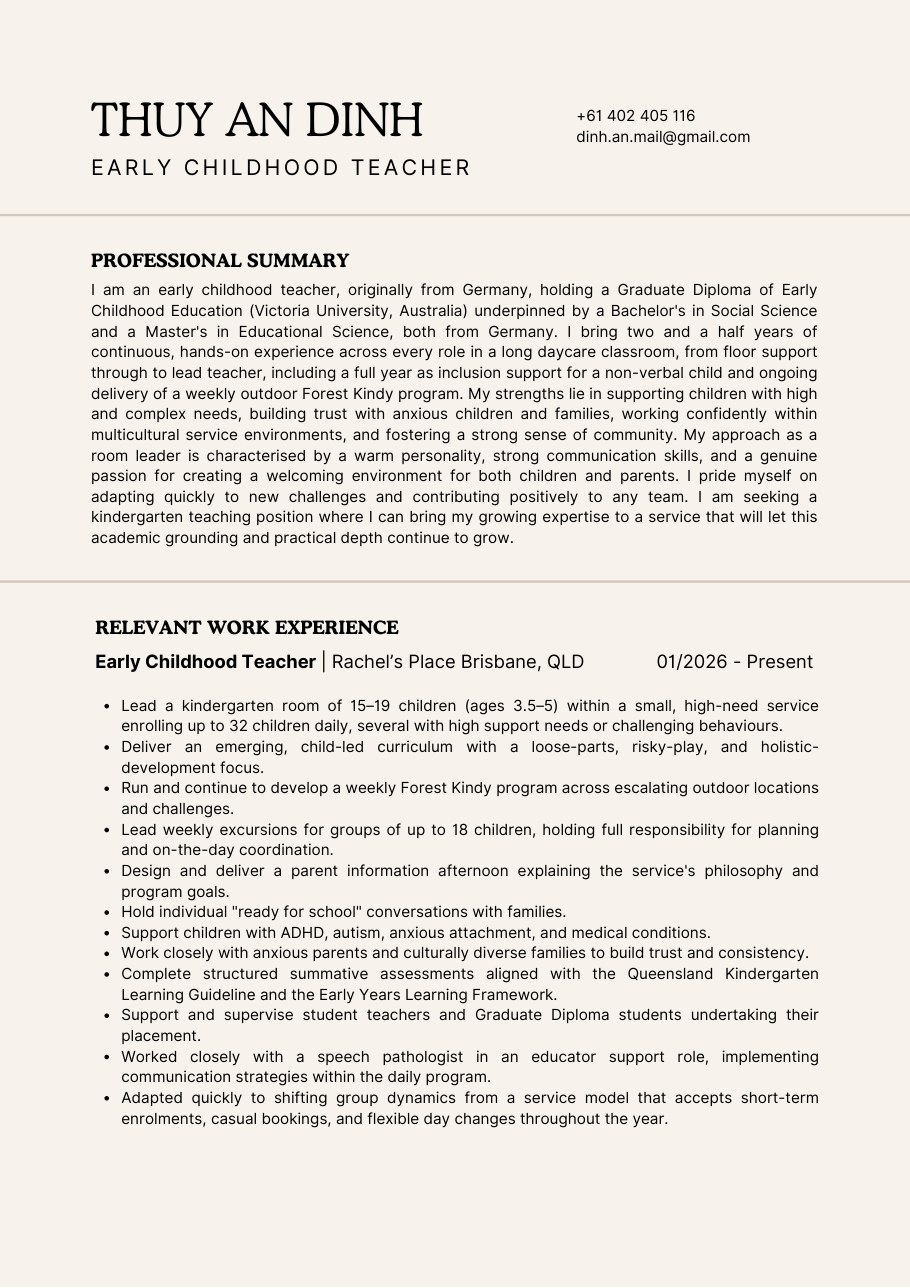
Experience

Experience across every role in the room

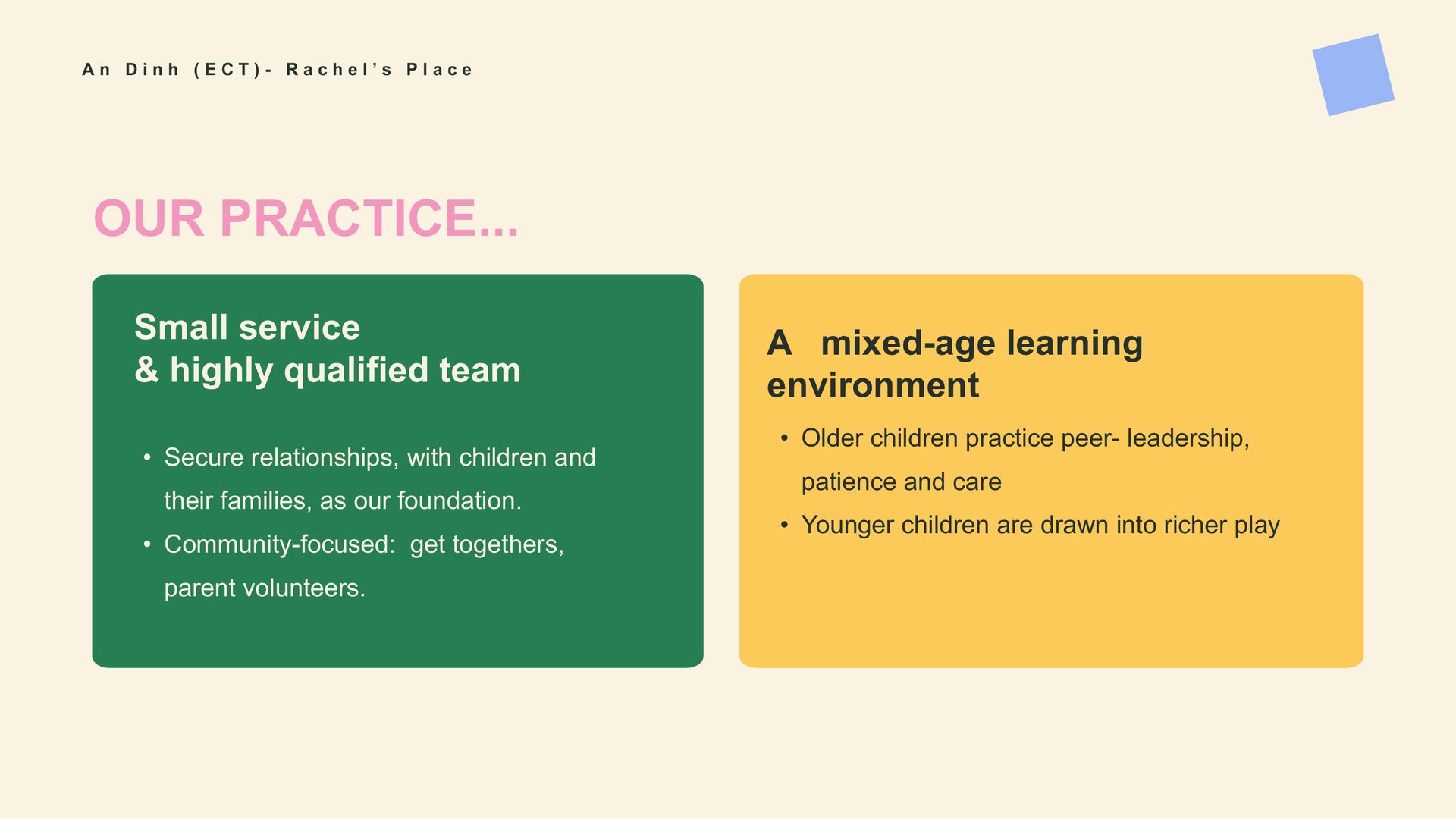
At Rachel's Place, a small, close-knit long day care service with families from all over the world, I've grown from relief educator to Kindy teacher and room leader.

Jan 2026 – present

Kindy Teacher and Room Leader

Early Childhood Teacher · Rachel's Place, Brisbane

  • Lead a play-based, emergent program for 15–19 children aged 3.5–5, including children with high support needs
  • Plan and lead a weekly excursion program for groups of up to 18 children, including risk assessments and family communication
  • Organise community events and outings, from a family music morning to library visits, a community garden walk and a fire service visit
  • Write mid-year and end-of-year summative assessments aligned with the EYLF V2.0 and state learning guidelines
  • Build transition-to-school partnerships with a local primary school, and run school readiness chats with families
  • Work alongside a speech pathologist, and adapt practice for children with hearing, language and additional needs
  • Supervise and mentor student teachers on placement
Jan 2025 – Dec 2025

Inclusion Support Educator

Rachel's Place, Brisbane · 24 hours a week during my studies

A full year supporting a non-verbal child in the kindy room alongside educators with 10–15 years' experience. I introduced visual supports, nurtured friendships through play and taught the class about allyship and different abilities. Over that year I also built a close relationship with the child’s parents.

Aug 2024 – Dec 2025

Educator and Relief Educator

Rachel's Place, Brisbane

Worked across the Kindy, Pre-Kindy and Junior rooms as break and holiday cover: maintaining and resetting spaces, setting up play invitations and provocations, and learning the pace and needs of every age group.

Beyond the room

Some of the events and outings I've organised

Connecting children with families and their local community is a big part of how I teach.

Friday Jam

For Family Week, I invited parents to join us for music and a chat. Children and parents brought instruments from home and played for each other.

Community garden walk

We walked to a community café and garden down the road, the sister café of the one where we hosted an exhibition of the children’s artwork. We’ve been building relationships with local shop owners and our wider community. We picked herbs from the garden and used them to season the pizzas we made back at the service.

Library excursion

I planned and led a visit to the local library with the whole class, building early literacy, independence and a sense of the wider community.

Fire service visit

I reached out to the local fire service and invited them to visit with their fire truck, then turned the visit into a letter-writing project for the children.

Looking up at the gums
Building a sand river
Collage inspired by artists
Testing our strength
Projects & learning spaces

Spaces and projects that invite wonder

Examples of the learning environments and long-term projects I have planned and led, from excursions and inclusion to science, art and allyship. Select any photo to see it larger.

Excursion program

Weekly bush excursions

See project →
See project

Weekly bush excursions

I plan and lead a weekly excursion program for groups of up to 18 children: risk-benefit assessments on site, ratio coordination and all other on-the-day coordination, as well as permission forms and a learning story for families afterwards. Each session includes an Acknowledgement of Country, and child-led play that I observe, document and extend.

The program has had its biggest impact on children who find a busy room overwhelming. With more space and fewer demands, several neurodivergent children played, communicated and connected with their peers in ways we rarely saw indoors.

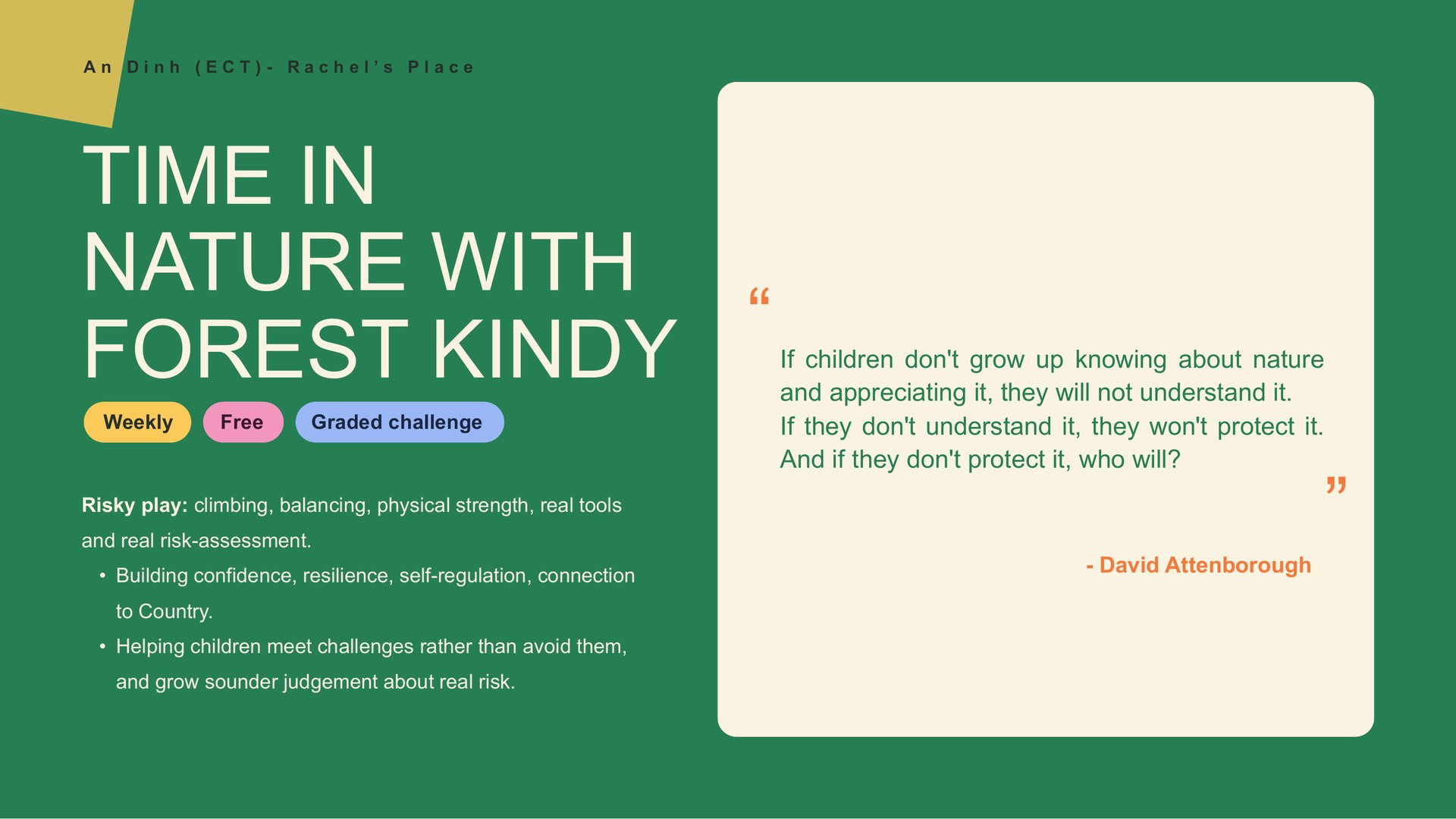
Supported risky play built confidence and the ability to assess risk for themselves, and children learned to work together on shared challenges, such as planning and building a shelter as a team.

Back at the service, I connect what the children noticed to science, maths and language, from water flow and erosion to using precise new vocabulary.

Long-term project

Our seasonal nature book

A year-long, child-made record of local nature across every season.

See project →
See project

Our seasonal nature book

Throughout the year the children photograph and record the seasonal bugs, plants and natural treasures they find worth capturing, both at the service and on our weekly excursions. A cicada shell, a gum leaf, the first sprouts of spring: each find goes into our class nature book, alongside the children’s own words about what they noticed.

By the end of the year we have a collection of local nature across every season, made entirely by the children. It builds observation and scientific vocabulary, gives children a reason to slow down and look closely, and becomes a shared record they are proud to revisit.

Long-term project

Little World & our neighbourhood

A travelling mascot and a giant class map that connect children with their community.

See project →
See project

Little World & our neighbourhood

The Little World idea started on our first Forest Kindy excursions, when the children kept trying to work out which direction we were heading. When I took out the iPad and showed them our route on a map, their interest in maps took off. It fitted perfectly with that term’s topic, “Our people, our places”, so we decided to make a map of our own community, and that’s how Little World got rolling.

Mapping our neighbourhood

Using a printed street map on a clipboard as our guide, we drew a giant map together: first the outline of the river, then the streets, parks and the places the children know, labelled so they could find them again.

The children coloured the river with long, careful strokes and added the green of the parks, comparing their map with the real one as they went. It built early mapping and spatial language (bends, next to, across the river), a strong sense of belonging to their community, and lots of conversation about where each child lives, as they recognised places they had visited with their families.

Little World, our class mascot

Little World went home with a different child for a few days at a time. Together with their family, the child photographed the anchor points of their everyday life: the tree they always walk past on the way to care, the First Nations artwork on the ground they cross before going into the supermarket, the friendly owners of the açaí café they say hello to every Saturday.

Back at the service, children shared Little World’s journal with the group. Seeing each other’s places through pictures helped children connect with where they live, notice the people and places that make up their community, and build a real sense of belonging. It was also a wonderful way to include our families in the program, and a joyful way for them to take part in their child’s learning.

Learning project

Loose parts & "Things that Go"

Ramps, blocks, rivers and road signs, and a whole term of real engineering.

See project →
See project

Loose parts & "Things that Go"

Tyres, cones, pipes and planks turned our yard into a science lab. Children tested why some objects roll slowly and others fast, compared smooth and bumpy planks, and changed the angles of pipes to redirect water. They worked out the flight path of a car leaving a ramp, and discovered with pulleys that a team can lift more than one person alone.

Balancing blocks and multi-storey bamboo houses explored height, weight and balance. In one play sequence, a child measured the height of water using a block that had earlier been a barricade.

Open-ended loose parts such as wooden blocks, fabric, peg people and natural materials sit on low tables so children can start building the moment an idea arrives. A strip of blue fabric became a river, then a bridge challenge for the animals crossing it.

Learning project

Cooking as science

How a room full of picky eaters became brave food scientists, from bread to guacamole.

See project →
See project

Cooking as science

This year I noticed we had a lot of picky eaters, and children who struggled to eat the food provided. To help them understand what food is for, we learned about our bodies, how food travels through them, and why we need it, such as for nutrition. I introduced child-friendly language: imagine there is a fire in our tummy, and to keep it going we need to fuel it with food. Too much or too little puts the fire out. We also talked about “always” foods and “sometimes” foods.

Then we made food fun. This year I had one child who struggled with food and mostly ate only bread. When I sat with him at meal times to give him comfort, he often asked me bread questions: why does bread sometimes have big holes, why is there white dust on the crust, why is there a crust at all? So I asked whether he’d like to make our own bread. He agreed, and became my leading friend in the project. We measured, read the scales and learned how yeast makes the gas that fills bread with air bubbles.

From there, food projects became a regular part of our week. On a hot day we blended banana smoothies. One of our educators, who is Thai, helped us cook Thai fried rice served in a pineapple. A guacamole taste test, one batch with coriander and a little garlic and one without, led us into learning about oxidation as the avocado turned brown.

Along the way we also learned about food allergies and intolerances, and why some friends eat differently. Children prepare fruit with child-safe knives and real chopping boards, too.

These experiments were wonderful opportunities to learn about science and chemistry, and about our senses of taste and smell. They were also about being brave: watching our friends try new foods, and knowing it’s okay not to like something and put it away.

Process art

Out-of-the-box art

Big, joyful, explorative art that’s about the journey, not the finished product.

See project →
See project

Out-of-the-box art

Big, fun, explorative art is one of my favourite ways to include children who aren’t drawn to traditional sit-down drawing. I want children to learn that art is about the journey: having fun, discovering things along the way, and seeing that things can be beautiful in very different ways. Tastes and opinions in art can differ, and we practise sharing them respectfully and kindly.

I draw inspiration from famous artists, both modern and traditional, and colour theory is a great way to make art fun. Children dropped coloured vinegar onto trays of bicarb soda and watched it fizz, spread and mix, made rainbow brushes by bundling cotton buds, painted big with their feet, and built collages from cut circles inspired by modern artists.

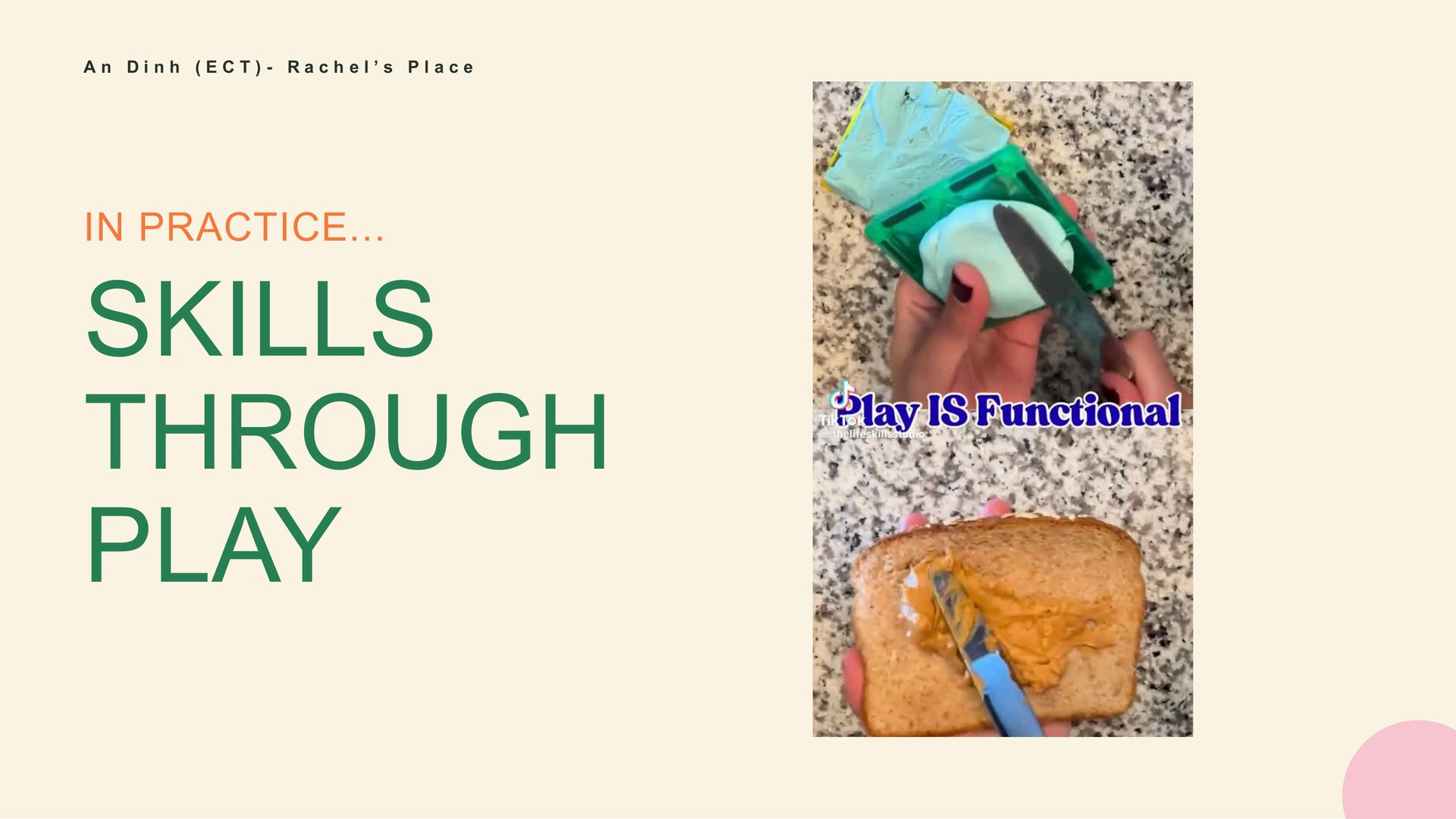
Of course, art is also one of the most exciting ways to practise fine motor skills, so I introduce lots of different tools and materials, from clay to playdough.

One of my favourite projects is mixing skin tones from primary colours. Children discover just how many different shades and pigmentations there are, and that we are all different, but the same.

Long-term project

Kind friends & allies

What it means to stand up for others, and the flags we hoisted in our mango tree.

See project →
See project

Kind friends & allies

One example of how I teach respect, kindness and social skills. I believe a big part of social skills is being respectful and kind. That doesn’t mean not setting boundaries; it also means being advocates and allies for others.

During Pride Month we talked about what an ally is. Being a good friend matters, but so does being kind to people who aren’t our friends when they are hurt and might need help: someone being pushed, having a toy taken away, or being spoken to unkindly. How can we support them? How can we fill up their buckets?

From there we talked about how we can show others that we are kind, supportive people, and one way is through symbols. When a child noticed the First Nations and rainbow flag pins on my hat, they asked me what they were and why I wear them. I explained that they are flags, and that the pins are symbols that help people quickly recognise me as a supportive friend. I asked the children how we could include those symbols in our own space, and together we decided on big flags. The children used the knotting skills they had learned to tie the flags on, and we hoisted them in our mango tree.

Credentials

Qualifications & checks

Education
2024 – 2025

Graduate Diploma in Early Childhood Education

Victoria University, Australia · Grade 90–100%

ACECQA-approved early childhood teacher qualification.

2020 – 2023

M.A. Education Sciences

University of Hamburg, Germany · Grade 90–100%

Educational psychology and pedagogy.

2015 – 2019

B.A. Social Sciences

Georg-August-University Göttingen, Germany

Working in Queensland, I haven’t needed NSW checks until now. Both are in progress and will be in place before I start.

Teaching qualification

Graduate Diploma in Early Childhood Education (Victoria University, 2025). On ACECQA’s list of approved early childhood teacher qualifications.

NESA accreditation

Early childhood teacher accreditation with the NSW Education Standards Authority (NESA).

Working with Children Checks

Current Queensland Working with Children Check (Blue Card) · NSW Working with Children Check.

First aid & safety

First Aid & CPR (current) · National child safety training (Geccko) · Child-safe device practice

Professional learning

First Nations professional development with Raindrops of Diversity · Forest Kindy professional development (2025) · ongoing learning in inclusive practice and neurodiversity

Referees

Professional referees from my current service are available on request. Credentials are issued under my full name, Thuy An Dinh.

Practice against the National Quality Standard

Evidence across all seven quality areas

My work sits within the EYLF V2.0, the National Quality Framework, the Australian Professional Standards for Teachers and the Child Safe Standards.

  1. 1

    Educational program & practice

    Emergent, interest-led program, term topics, mid and end-of-year summative assessments, floorbook and critical reflection.

  2. 2

    Children’s health & safety

    Risk-benefit approach to play, active, hands-free supervision on excursions, allergy-aware routines, factual incident reporting.

  3. 3

    Physical environment

    Open-ended materials, an accessible arts trolley, labelled resource homes, purposeful indoor and outdoor learning spaces.

  4. 4

    Staffing arrangements

    Room leadership, mentoring student teachers, systems that make opening, closing and lunch cover smoother.

  5. 5

    Relationships with children

    Co-regulation, faded scaffolding, explicit social language for joining and leaving play.

  6. 6

    Families & community

    Daily communication, school readiness chats, local school transition partnership, parent volunteers.

  7. 7

    Governance & leadership

    Initiating team systems with colleague feedback, reviving service traditions, professional external communication.